Ah, the Uffizi Museum (called the “Offices” because of its location in what was once a suite of super-fly office suites for grand ducal bureaucrats). I’m no longer sure that it quite deserves its reputation as one of the world’s top museums. Sure it has masterpieces, including just about everything from the Italian Renaissance section of your college art history textbook, but it has some big downsides: e.g., if you want to get a close look at the “Primavera,” be prepared to elbow your way through one of the massive tourist groups which populate the place, and the signage is almost non-existent, in a we-assume-you-already-know-everything-about-this kind of way. Plus the line, even with reservations, is ridiculous, and the toilet facilities are guaranteed to make you want to hold it – in short, the whole experience, apart from 15 or so mind-blowingly amazing paintings, is fairly unpleasant. The Uffizi is the Ron Jeremy of museums.
Sunday, May 23, 2010
Special Dispatch from Florence: May 12: Biblioteca Laurenziana (Laurentian Library)
The Laurentian Library is part of the San Lorennzo complex, a massive church and monastery heavily patronized by the Medici family. The Library itself is worth visiting, if only to see the lobby, designed by Michelangelo in a whack-tastic manner which I’m calling “pre-modern post-modern.” The Library’s main room is also interesting, with cramped wooden benches onto which the books were chained, leading me to picture all Renaissance scholars as kleptomaniac dwarfs.
The Library also has special exhibitions featuring manuscripts and books from their collections. Their research is impressive and the published catalogs are good reading, but visiting the actual exhibition can be frustrating: lots of books in Latin where the sign says something like “this page describes diseases of the face” but without offering any translation.
Special Dispatch from Florence: May 11: Galleria d’Arte Moderna (Modern Art Gallery)
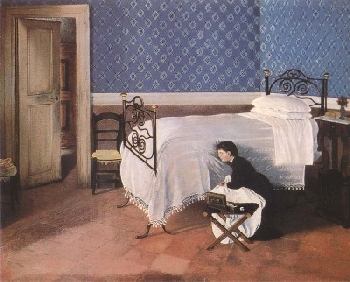
The underdog of the Pitti Palace museums, the Modern Art Gallery features hundreds of works from the time when even Italians would have agreed that art had moved to France. But that said… these works are pretty hilarious. Playing the “what are they saying?” game with 19th century genre paintings is endlessly amusing, e.g. this woman is clearly saying “you think you can steal my man? You’ll think again when you’re glued to your bed by my snot!” Also, the gallery is home to one of my most favorite works of art: a tabletop sculpture of a secretly pregnant nun, cowering in a corner: “Sixteen and Pregnant… and a Nun.”
Special Dispatch from Florence: May 11: Galleria Palatina (Palatine Gallery)
Special Dispatch from Florence: May 11: Museo degli Argenti (Silver Museum)
The Palazzo Pitti, a massive palace in Florence which was the seat of the Medici family when they attained the status of Grand Dukes, now holds several museums. I don’t even feel cheat-y b treating them in separate entries, because the complex is so large that it’s a long commute from one to the other. I do hang my head in shame because I didn’t even make it several of the Pitti museums, including the Costume Gallery, the Carriage Museum, and the Pottery Museum… wait, actually, no regrets about the Pottery Museum. I’m just not made to suffer that much.
Anyway… the Silver Museum is one of my favorite places in Florence. It shows, in rotating special exhibitions, the precious furnishings and objects d’arte of the Grand Dukes, and it’s hard to realize just how A) rich and B) bored these aristocrats were without seeing things like a 8-foot high cabinet filled with tiny landscape scenes made of exotic woods and semi-precious stones. Now, that had to take your mind off worrying about when you were going to produce a son and heir! Also, you’ll learn that the answer to “what household objects can I have in solid gold?” is “everything, your Highnesss!” Definitely worth a visit, if only to see just how far the Medicis out-blinged any MTV Cribs episode ever.
Special Dispatch from Florence: May 9: Palazzo Medici Riccardi, Museo dei Marmi (Medici-Riccardi Palace, Museum of Marbles)
The Medici-Riccardi Palace now sports a new museum in its basement, right by the toilets (just follow the smell of open drains). The design is futuristic, from the huge sliding glass panel at the entranceway (which doesn’t keep out the smell) to the sleek brushed-steel cases with pin-lights (of fluorescent light which turns some of the statues green). Except for a case displaying the things they found while digging out the museum space (mostly broken medieval pottery, proving my cherished theory that every single museum in western Europe features majolica), the sole objects on display are ancient Roman busts or heads, collected from the 16th century on by the occupants of the palazzo. Or should I say “ancient” – I would estimate that not more than five of the things were actually carved in antiquity, and even they are so reworked that it’s hard to take them too seriously. Go if you’re interested in what is essentially the “old guy’s heads” section of the 1684 Neiman Marcus catalogue – otherwise, stick to the rest of the palazzo.
Special Dispatch from Florence: May 9: Palazzo Medici Riccardi (Medici-Riccardi Palace)
The Medici-Riccardi Palace was home base for the Medici family, Florence’s famous bankers/dictators/art patrons. The more well-known paintings and sculptures commissioned by the Medici are elsewhere in Florence, but this palazzo retains some interesting things, such as copious amount of ancient crap set into baroque frames (“ancient crap” is the technical term for little broken bits and pieces of sarcophagi, architectural decoration, etc.) and the Chapel of the Magi, a tiny but high-intensity chapel painted with scenes of the Three Wise Men visiting the infant Jesus, in which almost every figure is a portrait of a Medici family member or associate, in a sort of “Hey Jesus – you need some myrrh? We got your myrrh right here!” fashion.
The palazzo also hosts temporary exhibitions, which are almost uniformly on my all-time list of most tedious collections of objects ever. This time it was an exhibition on science in 19th century Florence, a.k.a. “we spend our time making decorative cabinets in which to place the inventions produced by other countries.”